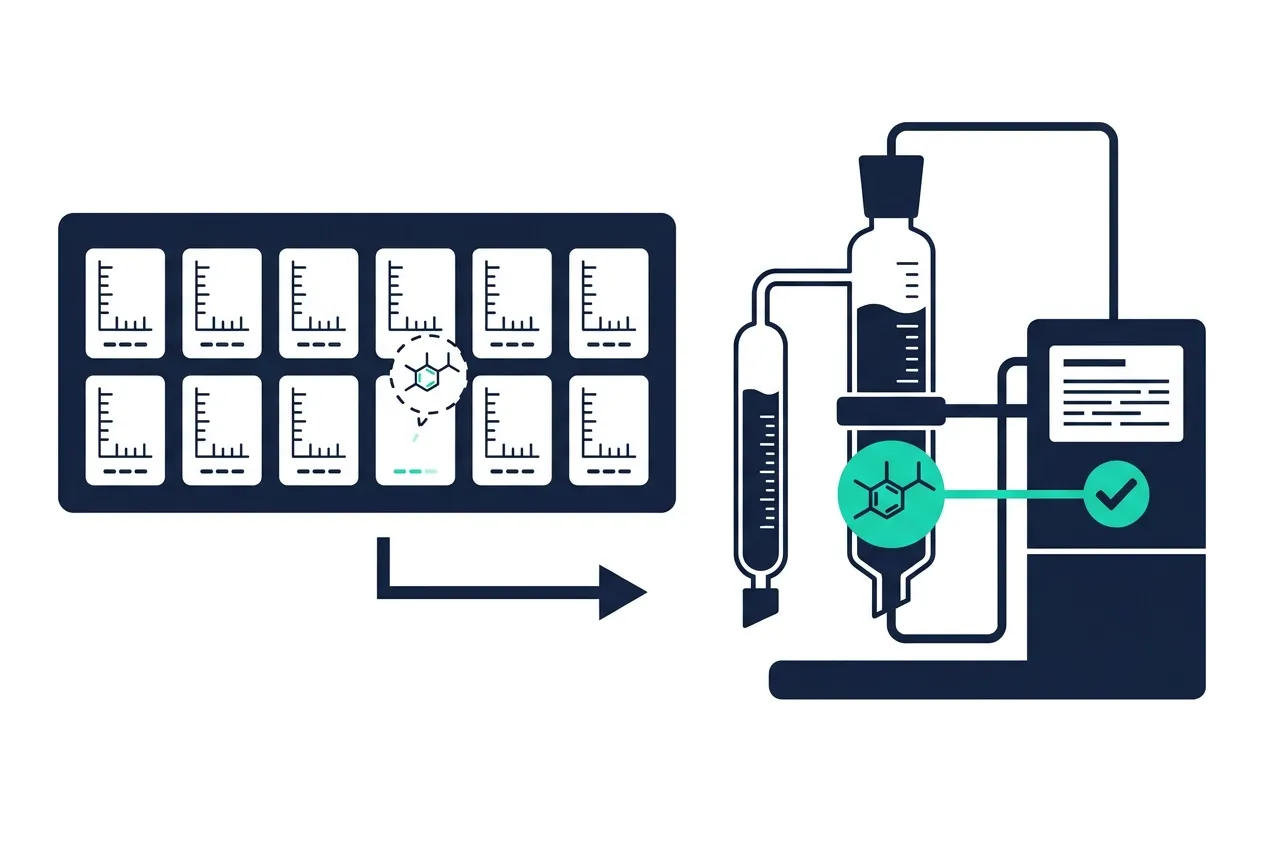
The short answer is yes. Every Testr 14-panel urine drug test has a dedicated fentanyl panel, printed on the report as FEN. The longer answer is about what that panel can and cannot tell you: it reads positive or negative against a cutoff, it is an immunoassay rather than a chemical identification, and a laboratory result is the one that names the compound and measures it.
What a 14-panel drug test screens for
Not every product sold as a "14-panel" test screens the same 14 classes. This is the Testr panel, read on site by a certified collector:
AMP (Amphetamine)
MET (Methamphetamine)
THC (Cannabis / Marijuana)
COC (Cocaine)
MOR (Morphine / Opiates)
OXY (Oxycodone)
MTD (Methadone)
BZO (Benzodiazepines)
BUP (Buprenorphine / Suboxone)
BAR (Barbiturates)
MDMA (Ecstasy / MDMA)
PCP (Phencyclidine)
FEN (Fentanyl)
ETG (Alcohol metabolite)
Three validity strips, pH, oxidants and creatinine, check the specimen itself rather than looking for a drug. Hydrocodone and propoxyphene, which appear on some other cups, are not on this panel; neither are kratom or psilocybin, though both are on the laboratory confirmation menu. Each code, with its cutoff and detection window, is decoded on the abbreviations page.
How the FEN panel reads
Each panel on the cassette is a strip built around an antibody that binds a class of compounds. As urine moves across the strip, the drug, if present, competes with a labelled reagent for that antibody. At or above the cutoff the drug wins and the panel reads presumptive positive; below it, the panel reads negative.
The FEN panel reads against a 10 ng/mL screening cutoff, and fentanyl is usually detectable in urine for 1-3 days after use. Other cups may print the same panel as FYL and may use a different cutoff, so the number beside the code matters as much as the code. The fentanyl panel page has the full detail.
What a negative means
A negative FEN panel means the specimen was below 10 ng/mL at the time of collection. It does not mean fentanyl was never present. Use several days earlier, a small amount, or a dilute specimen can all leave a level under the cutoff, and the panel will read negative.
That is true of every panel, not only fentanyl. Negative is a statement about a cutoff on a given day, read alongside the detection window on each panel's page.
What the panel may not catch
A rapid cassette is an immunoassay. The antibody on the FEN strip was developed against fentanyl itself, and how strongly it binds a related compound depends on how similar that compound's structure is. This is called cross-reactivity. Some fentanyl analogues bind well enough to trigger the panel at ordinary levels. Others bind weakly, and a specimen containing one of them can read negative even when the compound is there in a meaningful amount.
The cassette cannot tell you which case you are in. It reports one result for the FEN lane, positive or negative against the cutoff. It does not say which compound crossed the line, or whether a compound with low cross-reactivity was present below it. When the question is "was there fentanyl or something like it," the rapid read is a first pass. When the question is "which compound, and how much," it is the wrong tool.
What laboratory confirmation adds
If you order the Rapid Test with Laboratory Confirmation, the collector seals the specimen under chain of custody after the rapid read and it travels to a CAP-accredited laboratory. The laboratory does not use a strip. It uses LC-MS/MS, liquid chromatography with tandem mass spectrometry, which separates the compounds in the specimen, identifies each one by its mass and fragmentation pattern, and reports a measured level. Results come back in about 72 hours.
For fentanyl, the laboratory's confirmation menu lists fentanyl and norfentanyl, its main metabolite, and reports a measured level for each. The menu covers 81 substances in total. It does not list individual fentanyl analogues by name, so a confirmation report should not be expected to name an analogue beyond those two compounds.
A laboratory report also explains a prescription. A valid fentanyl prescription, for patches or lozenges for example, can cause a positive on the FEN panel. The laboratory reports a measured level, and every laboratory report is reviewed by a Medical Review Officer (MRO), a physician who reviews laboratory-confirmed results and accounts for valid prescriptions before the report is released.
When to add confirmation
Confirmation is worth adding when the answer will be relied on: a presumptive positive that someone may contest, a result that will be shown to a reviewing professional or an employer, or a negative that is not enough reassurance on its own. If you booked the At-Home Rapid Test and want the laboratory behind it after seeing the rapid read, you can upgrade in the app within 2 hours of collection, while the sealed specimen is still viable.
Both tests are booked the same way, in the Testr app or on the booking page. A certified collector arrives in as little as 3 hours, 7 AM to 7 PM, seven days a week, verifies their identity with the 4-digit PIN in your app, collects the specimen and reads the cassette on the spot. Results are released privately to the account holder, in the app or in your account on the site, with a PDF on request, or to a named third party with the account holder's written consent. A professional can book for a client the same way, with the client's consent recorded at booking; see the professionals page. How each line on the report reads is covered in how to read a Testr drug test result.
Questions people ask
Does a 14-panel drug test detect fentanyl?
The Testr 14-panel does; it has a dedicated FEN panel with a 10 ng/mL cutoff. Some other 14-panel products do not include fentanyl, so check the panel list.
Is FEN the same as FYL?
Yes. Both are abbreviations for the fentanyl panel. A Testr report prints FEN; other cups print FYL, sometimes with a different cutoff.
Can the FEN panel miss fentanyl analogues?
It can. The antibody is built around fentanyl, and some analogues do not bind it well enough to reach the cutoff. Laboratory confirmation names and measures the compounds on its menu, which for this class lists fentanyl and norfentanyl.
How long is fentanyl detectable in urine?
Usually 1-3 days after use at the 10 ng/mL cutoff. Amount, frequency, body weight and hydration all move that range.
How long does laboratory confirmation take?
About 72 hours from collection, at a CAP-accredited laboratory by LC-MS/MS.