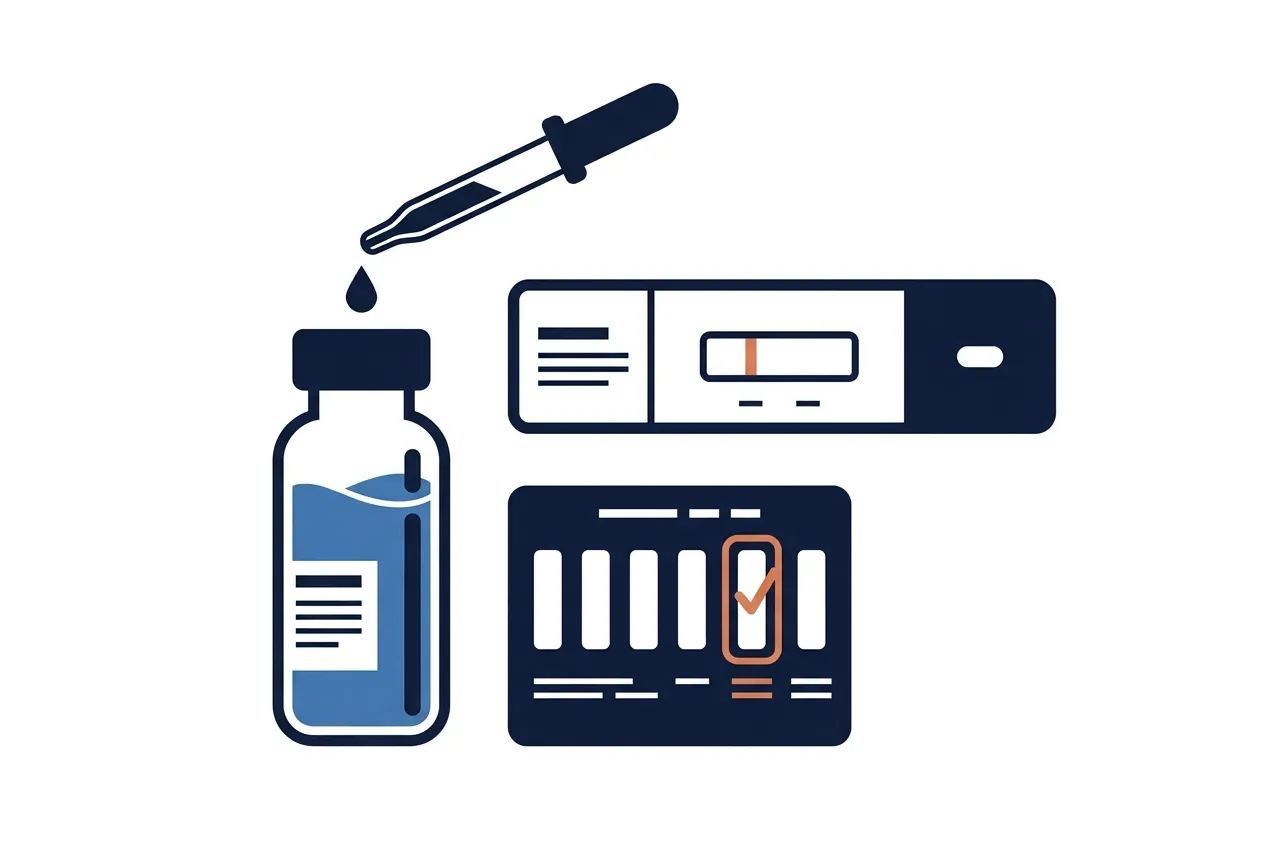
BUP is one of the short codes printed on a 14-panel urine drug test cassette, and one of the codes people look up most, because the drug it stands for is a prescribed medication for many of the people being tested. This is what the BUP panel screens for, where its cutoff sits, how long buprenorphine typically stays detectable in urine, and why the on-site read and the laboratory result are two different things.
What BUP stands for
BUP is buprenorphine, the medication in Suboxone and Subutex, prescribed for opioid dependence and sometimes for pain. On a Testr report the panel is printed as BUP (Buprenorphine / Suboxone), and it is one of the 14 panels read on every visit. The full list of codes, with each panel's cutoff and detection window, is on the abbreviations page.
Buprenorphine has its own panel because the opiates panel does not screen for it. The opiates panel (MOR on the cassette) is built around morphine and the natural opiates related to it: morphine, codeine and heroin. Buprenorphine is a different molecule, and a person taking Suboxone can read negative on MOR and positive on BUP in the same specimen. The same separation applies to fentanyl, oxycodone and methadone, each of which has its own panel for the same reason.
What the panel screens for
The BUP panel is an immunoassay strip on the rapid cassette. It reacts to buprenorphine at or above a set level and reports a yes-or-no read against that level. It does not report a number, and it does not identify which buprenorphine product was taken.
The certified collector reads each panel after the set development time and records it as negative or presumptive positive, without interpreting it. Three more strips check the specimen itself: pH, oxidants and creatinine. They are not drug panels, and a report lists them separately.
The 10 ng/mL cutoff
On a Testr screen the BUP panel reads positive at or above 10 ng/mL and negative below it. A cutoff is a level, not a time. A negative BUP means the specimen was below 10 ng/mL at the moment of collection, not that buprenorphine was never present. Other test cups can print BUP with a different cutoff.
10 ng/mL is a low threshold compared with the other opioid panels on the cassette: oxycodone reads at 100 ng/mL, methadone and opiates at 300 ng/mL. Buprenorphine is prescribed in small doses, and the panel's cutoff is set low enough that a person taking it as directed is expected to read positive.
Detection window
Buprenorphine is usually detectable in urine for 3-7 days after the last dose, at the 10 ng/mL screening cutoff. That range is typical rather than a guarantee. How much was taken, how often, body weight and hydration all move it, and a daily dose taken for months usually stays above the cutoff longer than a single dose.
The window and the cutoff go together. A specimen collected after that window may read negative even though a trace remains, which is why a single negative read, on its own, cannot say whether a person has been taking buprenorphine over the past week. The buprenorphine panel page keeps this window alongside the other opioid panels for comparison.
Presumptive positive versus laboratory-confirmed
A positive on the rapid cassette is a presumptive positive. The word matters. An immunoassay recognises a class of compounds rather than one exact molecule, and a presumptive positive is a screening result: a reason to confirm, not a conclusion on its own. Negative, presumptive positive and laboratory-confirmed are explained side by side in how to read a Testr result.
If the visit was booked as a Rapid Test with Laboratory Confirmation, the collector seals the specimen under chain of custody after the rapid read and it travels to a CAP-accredited laboratory. The laboratory does not use a strip. It uses LC-MS/MS, which identifies the specific compound and reports a measured level. For this panel the laboratory confirmation menu covers buprenorphine itself and norbuprenorphine, the main breakdown product the body makes from it, with a measured level for each. Results come back in about 72 hours.
A measured level is what makes a prescription question answerable. A positive is expected for anyone prescribed Suboxone. Every laboratory report is reviewed by a Medical Review Officer (MRO), a physician who reviews laboratory-confirmed results and accounts for valid prescriptions before the report is released. The rapid read alone only says whether the specimen was above or below 10 ng/mL.
If the visit was booked as an At-Home Rapid Test, laboratory confirmation can be added in the app within 2 hours of collection. The window is about specimen viability: after it, a new collection would be needed.
Who books a BUP screen, and how
A parent, an individual, or a professional can book. A therapist or family-law professional books for a client at testrla.com/book, with the client's consent recorded at booking, and the records and results come to the ordering account; see the professionals page. Workplace orders are non-DOT only; see workplace drug testing, and take questions about what a workplace policy may require to employment counsel.
Book in the iOS app or on the site, choose a 30-minute window, and a certified collector arrives in as little as 3 hours, 7 AM to 7 PM, seven days a week, across the Los Angeles area. The collector is verified at the door with the 4-digit PIN in your app. The BUP read, with the other 13 panels, is released privately to the account holder in the app or at testrla.com/account, with a PDF on request, or to a named third party with the account holder's written consent.
Questions people ask
What does BUP mean on a drug test?
Buprenorphine, the medication in Suboxone and Subutex. On a Testr report the panel is printed as BUP (Buprenorphine / Suboxone).
Will Suboxone show up on the opiates panel?
No. The opiates panel screens for morphine and related natural opiates. Buprenorphine is screened on its own BUP panel.
What is the BUP cutoff?
10 ng/mL on a Testr screen. At or above that level the panel reads positive; below it, negative. Laboratory confirmation reports a measured level rather than a cutoff read.
How long is buprenorphine detectable in urine?
Usually 3-7 days after the last dose at the 10 ng/mL cutoff. Dose, frequency, body weight and hydration all move that range.
Does the laboratory confirm buprenorphine specifically?
Yes. The CAP-accredited laboratory confirms buprenorphine and norbuprenorphine by LC-MS/MS, with a measured level for each, in about 72 hours.