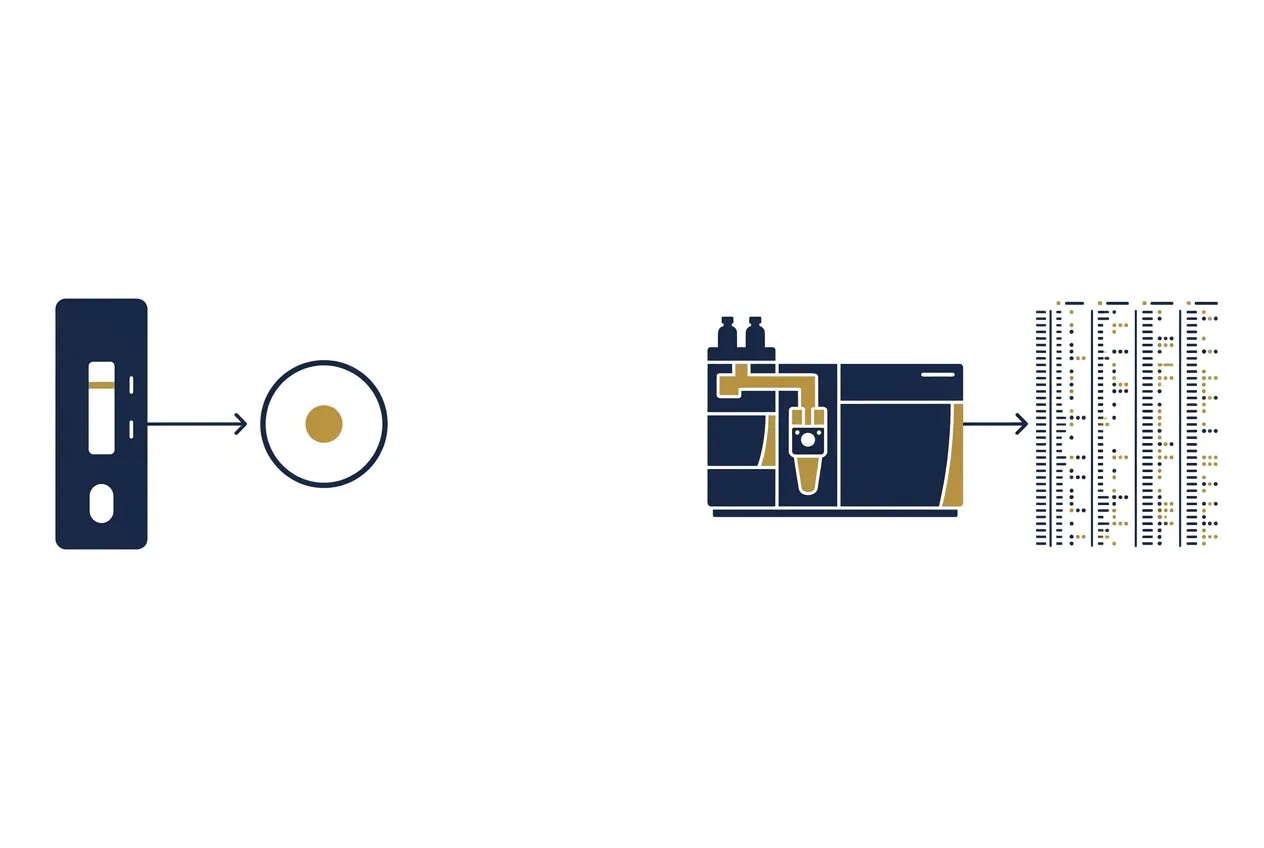
A rapid urine cup answers one question: is any of 14 drug classes present above its cutoff right now. Gabapentin, tramadol, LSD and muscle relaxants are not among those 14, so no cup Testr reads at your door will ever show them. The laboratory layer is different. Its confirmation menu covers 81 substances, those four families are on it, and each is reported as a measured level in about 72 hours. This is how the two layers fit together, and what the menu says about the substances people ask about most.
The two layers of a Testr result
Every Testr visit starts with the same 14-panel urine screen, read on site by a certified collector. Each panel is an immunoassay strip: an antibody reacts when a class of compounds is present above that panel's screening cutoff, and the collector records the panel as negative or presumptive positive. The 14 classes are amphetamines, methamphetamine, THC, cocaine, opiates, oxycodone, methadone, benzodiazepines, buprenorphine, barbiturates, MDMA, PCP, fentanyl and EtG, the alcohol metabolite. Three validity strips (pH, oxidants and creatinine) check the specimen itself. The cutoffs and detection windows for those 14 are on the 14-panel page, and the codes printed on the cassette are decoded on the abbreviations page.
Anything outside those 14 classes returns nothing, not because the strip is weak but because there is no strip for it.
The second layer is the Rapid Test with Laboratory Confirmation. After the on-site read, the collector seals the specimen under chain of custody and it travels to a CAP-accredited laboratory. There, liquid chromatography separates the compounds in the specimen and tandem mass spectrometry (LC-MS/MS) identifies each one by its mass and the way it fragments. No antibody is involved. The laboratory names the specific compound rather than the class, and reports a measured level in ng/mL rather than a yes-or-no against a cutoff. Its menu lists 81 substances across 31 drug classes, and the whole menu is included with every laboratory confirmation. Every laboratory report is reviewed by a Medical Review Officer (MRO), a physician who reviews laboratory-confirmed results and accounts for valid prescriptions before the report is released.
Does gabapentin show up on a drug test?
Not on the rapid cup. There is no gabapentin strip on any 14-panel cassette, so a rapid screen is silent on it whether or not the person takes it.
On the laboratory menu, yes. Gabapentin is its own class on the 81-substance list, with a confirmation cutoff of 500 ng/mL. A laboratory confirmation reports gabapentin as a measured level, and the same is true of pregabalin, which sits beside it on the menu at 250 ng/mL. Because gabapentin is usually prescribed, the Medical Review Officer's review is the step where a valid prescription is accounted for before the report is released.
Will tramadol show up on a drug test?
Not on the rapid cup, and this one surprises people. Tramadol is an opioid, but the opiate panel (MOR) reacts to morphine, codeine and heroin's metabolite; tramadol does not trigger it, and the oxycodone panel does not react to it either. A rapid screen can be negative on every panel while tramadol is present.
The laboratory menu carries tramadol as its own class with two entries: tramadol at 50 ng/mL and its metabolite, O-desmethyl-cis-tramadol, at 100 ng/mL. Both are reported as measured levels. The abbreviation TRA, which some reports use for it, is on the abbreviations page, alongside the other codes that appear on a laboratory report but never on a cup.
Does acid show up on a urine drug test?
Not on the rapid cup. LSD has no panel on the 14-panel cassette.
On the laboratory menu it does: LSD is listed under Psychedelics with a confirmation cutoff of 2 ng/mL. Psilocin, the compound psilocybin becomes in the body, is the other entry in that class; the mushrooms page covers it and it is not repeated here.
Do muscle relaxers show up on a drug test?
Not on the rapid cup. No 14-panel cassette has a muscle-relaxant strip.
The laboratory menu has a Muscle Relaxants class with three entries: carisoprodol at 100 ng/mL, cyclobenzaprine at 20 ng/mL, and meprobamate, the compound carisoprodol becomes in the body, at 100 ng/mL. So the answer to "does cyclobenzaprine show up on a drug test" is the same as for the others on this page: not on the cup, yes on the laboratory report, as a measured level.
Kratom, K2 and CBD, in one line each
Kratom's alkaloids, mitragynine and 7-hydroxymitragynine, are on the laboratory menu and on no cup; the kratom page has the detail. Four synthetic cannabinoid metabolites are on the menu, and the K2 page explains what that does and does not cover. CBD itself is not on the menu at all; what the THC panel measures, and why some CBD products still read positive, is on the THC page.
What is not on the menu
The menu is a fixed list. The laboratory tests for those 81 substances and reports on those 81. Mood stabilizers such as lithium are not on it. Newer synthetic cannabinoids beyond the four listed are not on it, and neither are fentanyl analogs other than fentanyl and norfentanyl. A confirmation ordered because of a substance outside the menu returns a complete report on everything on the menu and nothing about the compound in question.
So the check is simple. Find the substance on the list on the booking page before you book. If it is there, laboratory confirmation will name it and measure it. If it is not, no version of this test will.
How to get the laboratory layer
There are two ways. Book the Rapid Test with Laboratory Confirmation, and the specimen read at your door is sealed and sent on the same visit. Or book the At-Home Rapid Test and, if the on-site read raises a question, add confirmation in the app within 2 hours of collection; after that the specimen is no longer viable and a new collection would be needed.
Either way, a certified collector arrives in as little as 3 hours, 7 AM to 7 PM, seven days a week, anywhere in the Los Angeles area. Therapists and other professionals book the same visit for a client from the professionals page, with the client's consent recorded at booking. Book a visit when you are ready.
Why the result takes about 72 hours
The instrument run itself is short; the rest is the work around it. After the on-site read, the sealed specimen travels to the laboratory under its chain-of-custody code. On arrival it is accessioned: logged against that code, checked for an intact seal, and entered into the laboratory's system. It is then prepared for analysis and run alongside calibration and quality-control samples. After the run, a scientist reviews the data and confirms the quality controls passed, and the report goes to the Medical Review Officer before it is released. Testr quotes about 72 hours from collection for that whole sequence. The result appears in your account beside the rapid read, tied to the same custody code, in the app or at testrla.com/account, and you can download a PDF record whenever you choose. What each word on the report means is covered in how to read a Testr result.
Questions people ask
Does gabapentin show up on a drug test?
Not on a rapid cup. On a Testr laboratory confirmation, yes: gabapentin is on the 81-substance menu at a 500 ng/mL cutoff and is reported as a measured level.
Will tramadol show up on a drug test?
Not on a rapid cup, including the opiate and oxycodone panels. On the laboratory menu, yes: tramadol at 50 ng/mL and O-desmethyl-cis-tramadol at 100 ng/mL.
Does acid show up on a urine drug test?
Not on a rapid cup. LSD is on the laboratory menu under Psychedelics at 2 ng/mL.
Do muscle relaxers show up on a drug test?
Not on a rapid cup. Carisoprodol (100 ng/mL), cyclobenzaprine (20 ng/mL) and meprobamate (100 ng/mL) are on the laboratory menu.
Does cyclobenzaprine show up on a drug test?
Only on the laboratory report, at a 20 ng/mL cutoff, as a measured level.
Is the rapid screen wrong if the laboratory names something the cup did not?
No. The rapid screen reports a class above a cutoff; the laboratory names the compound and measures it. For the substances on this page the cup has no class to report.
Is the laboratory test urine too?
Yes. Testr collects urine only, and the same sealed specimen that was read at your door is the one the laboratory confirms.