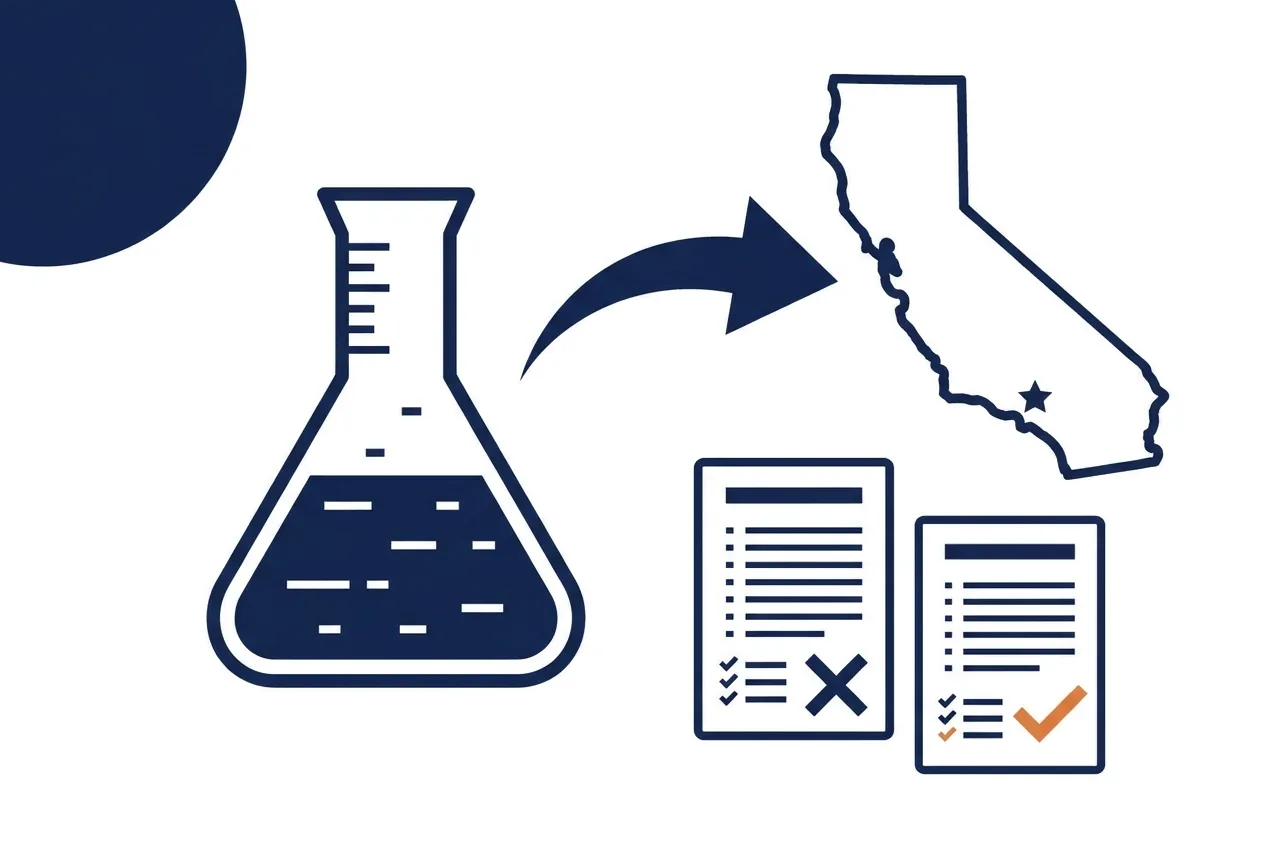
AB 2188 is a California law that became operative on January 1, 2024. It added Government Code section 12954 to the Fair Employment and Housing Act, and it concerns two things: a person's use of cannabis off the job and away from the workplace, and employer-required drug screening that finds non-psychoactive cannabis metabolites. Los Angeles employers who screen for drugs ask about it often, and the question underneath is usually a practical one: what does a urine THC panel actually measure?
This post answers that question for Testr's panel and describes what Testr does and does not offer. It does not say how the law applies to any employer's program. That is a question for employment counsel.
What the law is
Government Code section 12954 is one section of a larger statute. In plain terms, it addresses employment decisions that rest on a person's cannabis use off the job and away from the workplace, and employment decisions that rest on an employer-required drug screening test that has found non-psychoactive cannabis metabolites in hair, blood, urine or other bodily fluids. The section draws a line between those metabolites and the presence of psychoactive THC.
The section has its own definitions and its own exceptions, and a related bill, SB 700, took effect the same day. None of that is summarised here on purpose. Which parts of the law reach a particular employer, position or testing program depends on facts a blog post cannot know, and the answer belongs with employment counsel, not with a testing service.
What a urine THC panel measures
Testr's on-site screen is a 14-panel urine immunoassay, read by a certified collector at the address you choose. The THC panel on that cassette recognises the main cannabis metabolite, carboxy-THC (THC-COOH), at a 50 ng/mL screening cutoff. It does not measure delta-9-THC itself, and it does not measure impairment. A urine immunoassay for cannabis, from Testr or anyone else, is a metabolite test.
The detection window follows from that. The metabolite is usually detectable for about 3 days after occasional use, but up to 30 days or more with heavy daily use. Some legal CBD products contain enough THC to cause a positive result, which is one reason a rapid read is called a presumptive positive rather than a conclusion.
If you order the Rapid Test with Laboratory Confirmation, the collector seals the specimen under chain of custody after the rapid read and it goes to a CAP-accredited laboratory for LC-MS/MS confirmation. For cannabis, the laboratory reports the same carboxy metabolite, but with a measured level rather than a yes-or-no, in about 72 hours. The laboratory's confirmation menu covers 81 substances.
Both stages of a Testr cannabis result, the rapid read and the laboratory confirmation, therefore describe a metabolite. That is the fact an employer will want to state accurately when asking counsel how the law applies. How to read the two stages of any Testr result is covered in how to read a Testr result.
What Testr does and does not offer
Urine only. Testr collects urine specimens. It does not offer oral fluid, blood, hair or breath testing, for cannabis or for anything else.
Non-DOT only. Testr does not perform testing regulated by the U.S. Department of Transportation. An employee in a DOT-regulated position needs a DOT collection site.
Two products. The At-Home Rapid Test is the 14-panel screen read on site. The Rapid Test with Laboratory Confirmation is the same screen, followed by sealed transport to the laboratory. A rapid test can be upgraded to confirmation in the app within 2 hours of collection, while the specimen is still viable.
A record, not an interpretation. The collector records each panel exactly as the cassette shows it. Testr does not interpret a result and does not advise on what to do with one.
Private release. Results go to the account that booked the visit, in the Testr app or at testrla.com/account, with a PDF on request. Nobody else is sent a copy unless the account holder names a third party and gives written consent.
Booking. Book in the iOS app or on the booking page. A collector can arrive in as little as 3 hours, 7 AM to 7 PM, seven days a week, in 30-minute windows, and a 4-digit door PIN verifies the collector at arrival. You pay in the app. Employer bookings are described on the workplace drug testing page.
The other 13 panels
Cannabis is one panel of 14. The others screen for amphetamines, barbiturates, buprenorphine, benzodiazepines, cocaine, EtG alcohol metabolite, fentanyl, MDMA, methamphetamine, opiates (morphine), methadone, oxycodone and PCP. Three further strips check the specimen itself: pH, oxidants and creatinine. What each panel screens for, its cutoff and its detection window are listed on the 14-panel drug test page, and the short codes printed on the cassette are decoded on the abbreviations page.
Section 12954 concerns cannabis. A Testr visit reads all 14 panels together from one specimen.
One line for employers
Whether and how Government Code section 12954 applies to your drug-testing program, and what you may do with a cannabis result, are questions for employment counsel. Testr collects and reports. What a test is for, and what happens after a result, is governed by your own policy and your own advisors.
Questions people ask
Does Testr's THC panel detect active THC or a metabolite?
A metabolite. The rapid cassette recognises carboxy-THC at a 50 ng/mL cutoff, and laboratory confirmation reports the same metabolite with a measured level.
Can Testr do an oral fluid, blood or breath cannabis test?
No. Testr collects urine only.
Does a positive THC panel mean the person was impaired?
No. A urine metabolite result shows past exposure within the detection window. It does not measure impairment, and Testr does not offer a test that does.
Is Testr a DOT collection site?
No. Testr performs non-DOT testing only.
Who can tell me what AB 2188 means for my hiring or workplace policy?
Employment counsel. Testr can tell you what its panel measures and how a visit works, and nothing beyond that.